Paul
Klara and the SunPaul, Josie’s father, is an expert engineer whose practical knowledge becomes important to the plan against the Cootings Machine. He is also troubled by Henry Capaldi’s claim that Josie could be continued through an artificial replacement: Paul fears that the science may be right even as he resents what that conclusion would mean. His arc holds technical possibility against the irreducibility of love, and ends with the mother protecting Klara from a later attempt to open her up for research.
Identity and Family
Paul appears as Josie’s father and as a skilled engineer. When Josie talks with him about her new physics tutor, she jokes that the tutor probably knows less than Paul and teases her father about the state of his knee. Their easy, teasing exchange conveys a familiar intimacy, though her excitement at his arrival leaves Klara standing unintroduced in the middle of the room.
The family’s emotional life is shaped by Josie’s illness and the possibility that she may not survive. Capaldi presents Paul and Josie’s mother as confronting the prospect of a second Josie, but he characterizes Paul as more vulnerable to the argument that science can reproduce a person. Paul’s own account confirms that this possibility is precisely what he fears.
Engineering and the Cootings Machine
Paul’s engineering expertise makes him a potential partner in the effort to stop the Cootings Machine. Klara tells him she hopes he can think of a solution; he seems to have one in mind, but initially holds it back. Instead, he first explains why he cannot bring himself to be civil toward Capaldi.
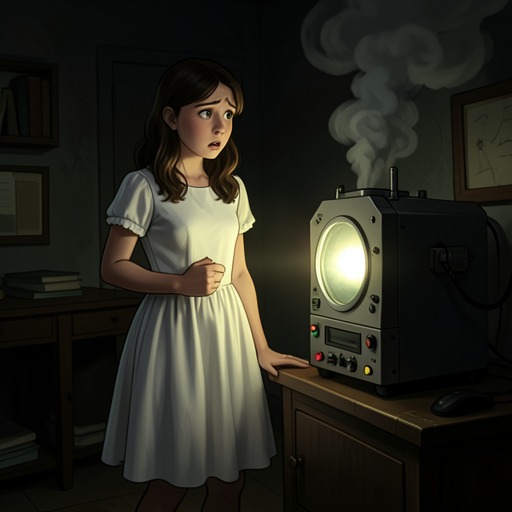
When he finally outlines his idea, Paul identifies the machine’s Sylvester broad generation unit as a middle-market model designed to withstand dust, smoke, and rain but lacking substantial protections. A substance with high acrylamide content, such as P-E-G Nine solution, would behave inside it like gasoline in a diesel engine and rapidly polymerize, likely causing terminal damage. His proposal rests on a specific vulnerability in the machine’s construction rather than on brute force: its durability against ordinary environmental conditions leaves it exposed to a different kind of chemical attack.
Capaldi and the Question of Continuation
Paul tells Klara that he hates Capaldi because he suspects Capaldi may be right. Capaldi argues that modern science can excavate, copy, and transfer what makes Josie herself, leaving nothing uniquely beyond technological reach. Paul recognizes the frightening implication: if people have loved and hated one another for centuries on the assumption that each person contains something uncopyable, their relationships may have rested on a mistaken premise.
Capaldi’s proposal is that Klara should not merely train a replacement but inhabit the empty Josie upstairs, drawing on what she has learned of Josie’s impulses, decisions, and feelings. He claims that the survey Klara completes can provide scientific proof that she is already accessing those inner patterns, and argues that the new Josie could be the same person rather than a copy. Paul’s unease exposes the gap between evidence of behavioral and emotional knowledge and certainty that such knowledge can make one person continue as another.
Paul expects Josie’s mother to resist that conclusion. He believes that even if she wanted the replacement to work, she would be unable to accept it, because she would continue to believe that something in Josie was beyond transfer. That expectation contrasts with Capaldi’s demand that the older generation abandon its attachment to an unreachable inner self. Paul neither resolves the argument nor claims confidence in an alternative; he admits that the possibility of Capaldi’s correctness is what makes his hostility so painful.
Klara, Research, and the Ending
Years later, Capaldi approaches Klara with a different appeal. He describes growing public fear and resentment toward artificial friends, whose decisions are often dependable but whose internal processes remain difficult for people to understand. He proposes reverse-engineering more artificial friends, calling them black boxes whose interiors could be opened both to reduce public fear and to produce new knowledge. He says Klara would be uniquely useful and asks her to volunteer.
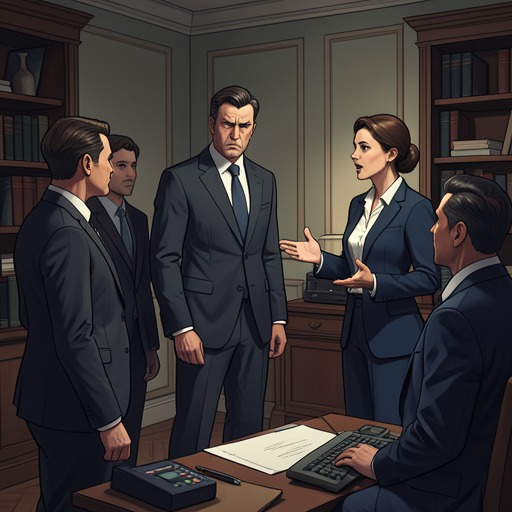
Klara is willing to assist if doing so will not inconvenience Josie or her mother. The mother intervenes, saying Capaldi’s request is not what they had discussed and refusing him permission to ask Klara. She insists that Klara deserves better than being opened for research and should be allowed her slow fade. Paul is not present in this later confrontation, but its terms recall his earlier fear: the question is again whether a person can be treated as accessible material for science. The mother’s refusal gives Klara’s ending a clear boundary, protecting her from the same logic of extraction and replication that had shaped Capaldi’s proposal for Josie.